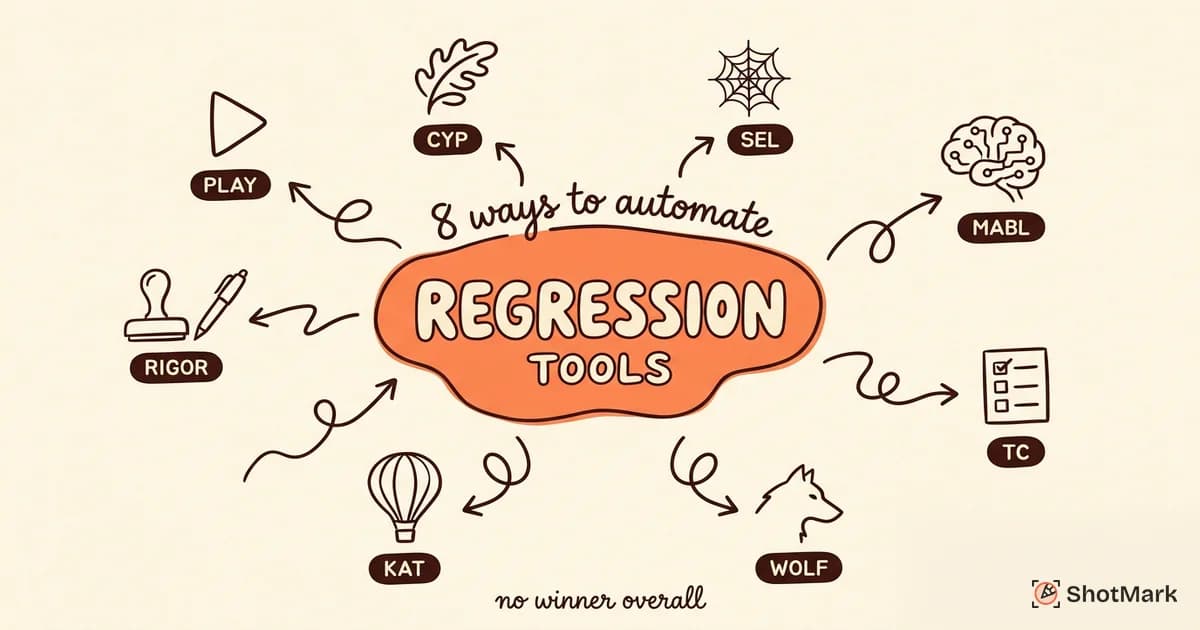
Regression testing automation tools save teams from hours of repetitive manual testing every release cycle. But picking the wrong tool wastes more time than it saves. We compared eight options across language support, browser coverage, learning curve, and real-world maintenance cost so you can choose based on your team’s actual needs.
Manual regression testing doesn’t scale. Every new feature adds test cases. Every bug fix risks breaking something else. Re-running the same suite of tests by hand each sprint is expensive, error-prone, and soul-crushing for whoever draws the short straw.
Automation fixes the scaling problem. The upfront investment is higher (writing tests, configuring CI pipelines, maintaining selectors), but the per-run cost drops to near zero. Teams that automate regression testing ship faster because they trust their test suite to catch regressions before users do.
CI/CD pipelines depend on automated regression. You can’t deploy multiple times a day if a human needs to manually verify core functionality after each push.
How We Evaluated These Tools
We focused on web application regression testing and scored each tool on six criteria:
- Language support: Can your team write tests in their primary language?
- Browser coverage: Chromium-only, or full cross-browser testing?
- CI/CD integration: How easy is it to run in a pipeline?
- Learning curve: Days or weeks to become productive?
- Maintenance cost: How often do tests break from unrelated UI changes?
- Community and ecosystem: How much support exists when you get stuck?
No single tool wins every category. The best choice depends on your team’s technical skills, budget, and testing scope. If you’re new to testing fundamentals, our guide to software testing basics covers the groundwork.
Regression Testing Automation Tools Compared
Playwright
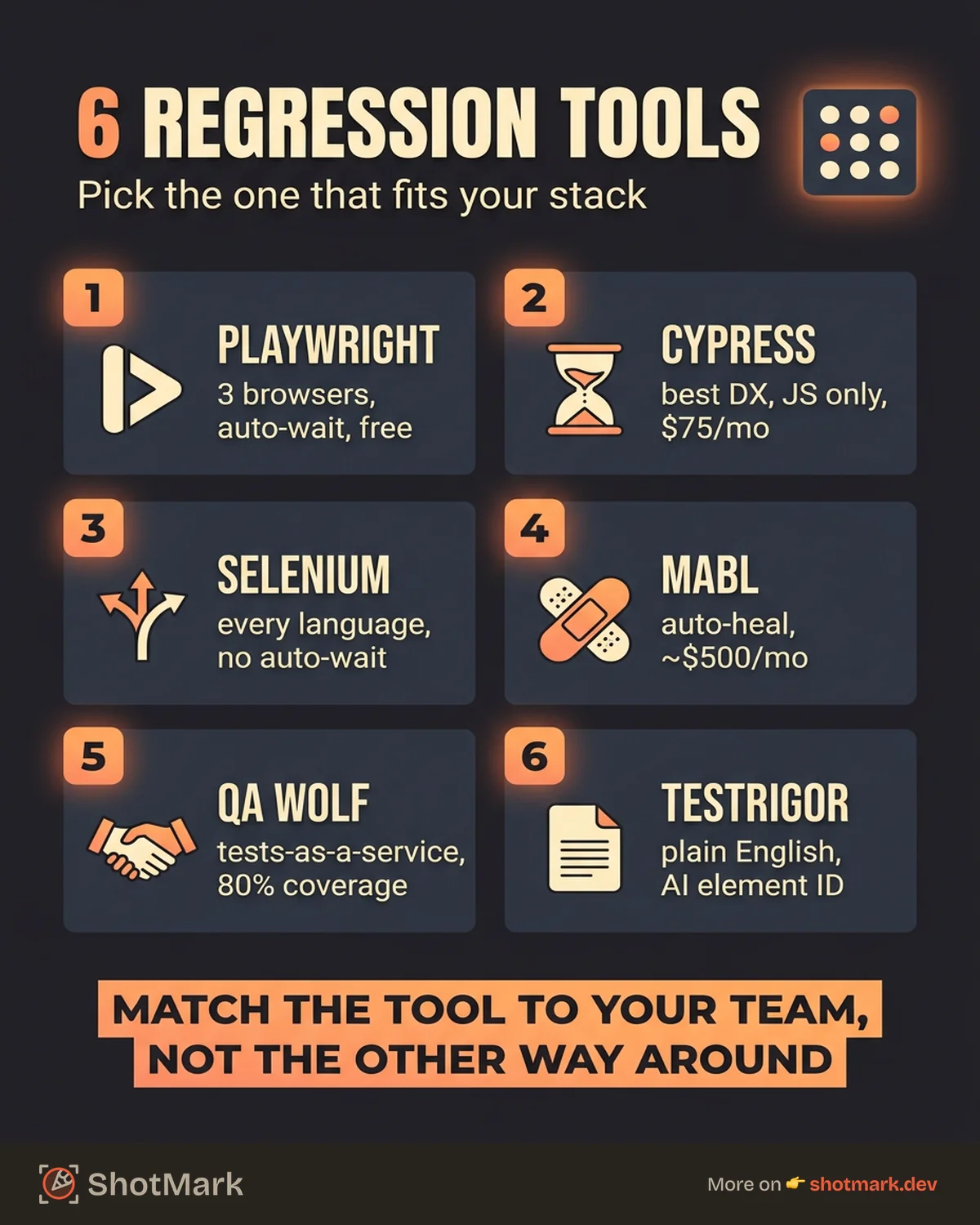
Playwright is Microsoft’s open-source browser automation framework. It supports Chromium, Firefox, and WebKit with a single API.
Strengths: Built-in auto-waiting eliminates most flaky test issues. The trace viewer records DOM snapshots, network requests, and console output for every test run. Code generation lets you record interactions and export them as test code.
Best for: Teams that want reliable cross-browser regression testing with modern tooling. Works well for both developers and QA engineers.
Pricing: Free and open source.
Cypress
Cypress runs directly in the browser, giving it fast execution and a developer-friendly debugging experience with time-travel snapshots.
Strengths: The test runner UI is the best in class for debugging. Cypress Cloud adds parallelization, dashboards, and test analytics. The API is intuitive for JavaScript developers.
Limitations: Single-tab testing only. Cross-browser support covers Chromium and Firefox but not WebKit. Some operations require workarounds (file uploads, iframes).
Best for: Frontend-heavy teams using JavaScript or TypeScript who prioritize developer experience over full browser coverage.
Pricing: Free (open source). Cypress Cloud starts at $75/month.
Selenium
Selenium is the oldest and most widely adopted browser automation framework. It supports Java, Python, C#, Ruby, JavaScript, and Kotlin.
Strengths: Massive ecosystem. Every CI tool, cloud provider, and testing platform integrates with Selenium. Selenium Grid enables parallel execution across machines.
Limitations: No built-in auto-wait (you manage explicit waits yourself). More verbose test code compared to modern frameworks. Setup is more involved.
Best for: Teams with existing Selenium infrastructure or teams that need multi-language support. Our regression testing explained guide covers when Selenium fits into a broader strategy.
Pricing: Free and open source.
TestComplete
TestComplete from SmartBear supports codeless recording and scripted testing across desktop, web, and mobile applications.
Strengths: AI-powered object recognition handles dynamic UI elements better than traditional record-and-playback tools. Supports keyword-driven and data-driven testing.
Best for: Mixed teams of technical and non-technical testers who need coverage beyond web applications.
Pricing: Starts around $3,500/year.
mabl
mabl is a cloud-native testing platform with AI-powered test creation and maintenance.
Strengths: Auto-healing tests adjust to minor UI changes without human intervention. Low-code test creation means non-developers can build regression suites. Built-in visual regression and accessibility testing.
Best for: Teams that want low-maintenance regression suites without deep coding investment.
Pricing: Custom pricing, typically starts around $500/month.
QA Wolf
QA Wolf takes a different approach: they write and maintain your regression tests for you. The underlying technology is Playwright-based.
Strengths: You get the benefits of automated regression without hiring QA engineers or training developers. They guarantee 80% automation coverage.
Best for: Teams that want regression testing as a service rather than building internal expertise.
Pricing: Custom pricing based on test count and coverage needs.
Katalon
Katalon is an all-in-one platform covering web, API, mobile, and desktop testing.
Strengths: Codeless recording with the option to add scripted logic. Built-in test management, reporting, and CI integration. Covers the full testing lifecycle in one tool.
Best for: QA teams that need one platform for everything rather than stitching together multiple tools.
Pricing: Free tier available. Enterprise plans start at $175/month.
testRigor
testRigor lets you write tests in plain English. No code, no selectors, no XPath.
Strengths: Tests read like instructions a human would follow (“click the button labeled Submit, then verify the text ‘Success’ appears”). AI-driven execution handles element location dynamically. Generative test steps can expand coverage automatically.
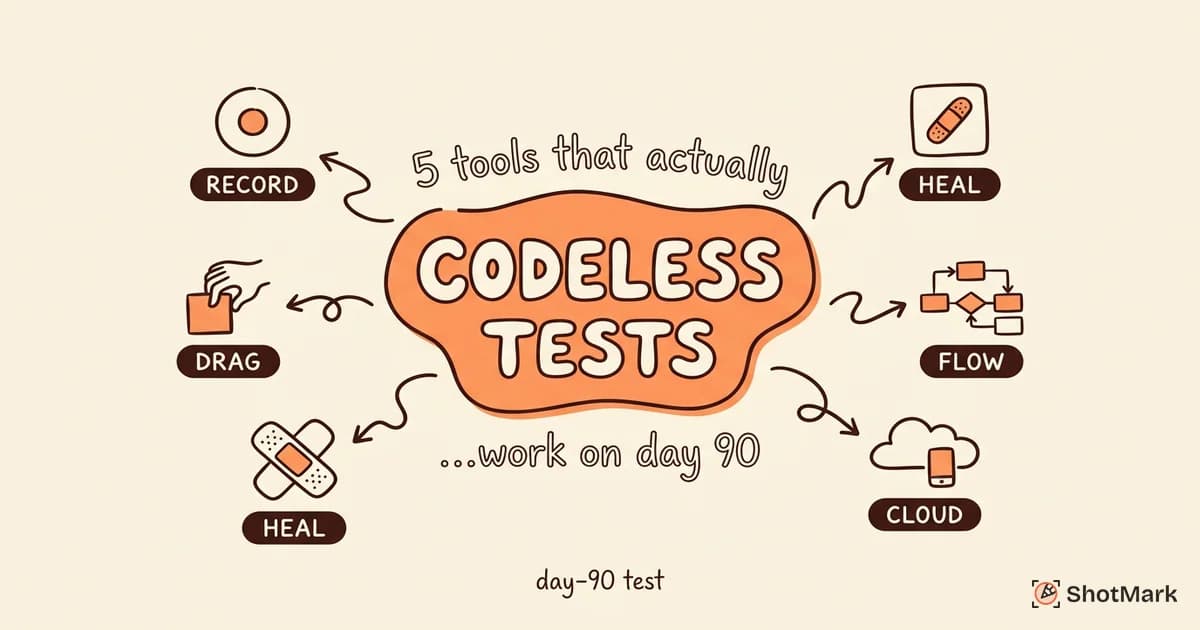
Best for: Non-technical team members who need to write and maintain regression tests. For teams exploring codeless options more broadly, our guide to codeless test automation tools covers the landscape.
Pricing: Starts at $500/month.
Comparison Table
| Tool | Languages | Codeless Option | CI/CD | Mobile Support | Pricing |
|---|---|---|---|---|---|
| Playwright | JS, TS, Python, Java, .NET | No (codegen only) | Excellent | Partial | Free |
| Cypress | JS, TS | No | Good | No | Free / $75+ |
| Selenium | 6+ languages | No | Excellent | Yes (Appium) | Free |
| TestComplete | JS, Python, VBScript | Yes | Good | Yes | ~$3,500/yr |
| mabl | Low-code | Yes | Excellent | No | ~$500+/mo |
| QA Wolf | Managed service | N/A | Excellent | No | Custom |
| Katalon | Groovy, JS | Yes | Good | Yes | Free / $175+ |
| testRigor | Plain English | Yes | Good | Yes | $500+/mo |
How to Choose the Right Tool
The decision comes down to four factors: team technical skill, budget, testing scope, and how fast you need results.
If your team writes code, start with Playwright or Cypress. Both are free, well-documented, and backed by active communities. Playwright wins on cross-browser coverage. Cypress wins on debugging experience.
If you need codeless testing, mabl and testRigor are the strongest options. mabl’s auto-healing reduces maintenance. testRigor’s plain-English approach is the most accessible for non-technical testers.
If you want everything managed, QA Wolf handles the full lifecycle. You provide the requirements, they deliver working automated tests.
If you need one tool for everything (web, API, mobile), Katalon covers the broadest surface area in a single platform.
For teams still building their automation foundation, our software testing automation guide walks through the setup process from zero.
Automated regression testing catches failures, but developers still need context to fix them. A failing test tells you something broke. A good bug report tells you why. ShotMark captures screenshots, console logs, and network requests alongside every bug, giving your team the full picture without the back-and-forth. Join the ShotMark waitlist and see how much faster bugs get fixed when the context is built in.
Get new posts in your inbox.
One email when we publish: notes on QA, AI, and shipping faster. No spam, unsubscribe anytime.