In 2024, AI testing tools were experiments that forward-thinking teams tried in parallel with their real workflows. In 2026, they are line items in QA budgets. The World Quality Report from Capgemini and Sogeti now tracks AI adoption as a standard metric. The State of Testing Report from PractiTest shows consistent year-over-year growth in teams using AI for at least one part of their pipeline.
So what actually changed? And what does it mean for testing teams who are still figuring out where AI fits? We looked at the data, tested the tools, and talked to QA leads. Here is where things stand and what AI in software testing looks like in practice.
The State of AI in Testing Today
AI in software testing has moved past the hype cycle’s peak of inflated expectations. Gartner’s Hype Cycle for AI in Software Engineering puts testing automation in the “slope of enlightenment” phase. Translation: the technology is real, the limitations are understood, and practical adoption is accelerating.
Most teams are in early adoption. They use AI for one or two specific tasks, usually visual regression or test maintenance, rather than overhauling their entire testing strategy. Budget allocation varies, but teams that invest in AI testing tools typically dedicate 10-20% of their QA tooling spend to AI-specific capabilities.
The maturity curve is real. Teams that started experimenting in 2024 now have production AI testing workflows. Teams that waited are starting with more mature, better-documented tools. The gap between early adopters and the majority is narrowing fast.
Adoption is not uniform across industries. Fintech and SaaS companies lead, driven by fast release cycles and competitive pressure on quality. Enterprise teams follow, usually starting with visual regression before expanding to AI-assisted test creation. Healthcare and defense lag, constrained by data privacy requirements that limit cloud-based AI tool use.
One pattern holds across industries: teams that succeed with AI testing start small. They pick one problem (usually test maintenance or visual regression), solve it with AI, measure the improvement, and then expand. Teams that try to transform their entire testing practice at once tend to stall.
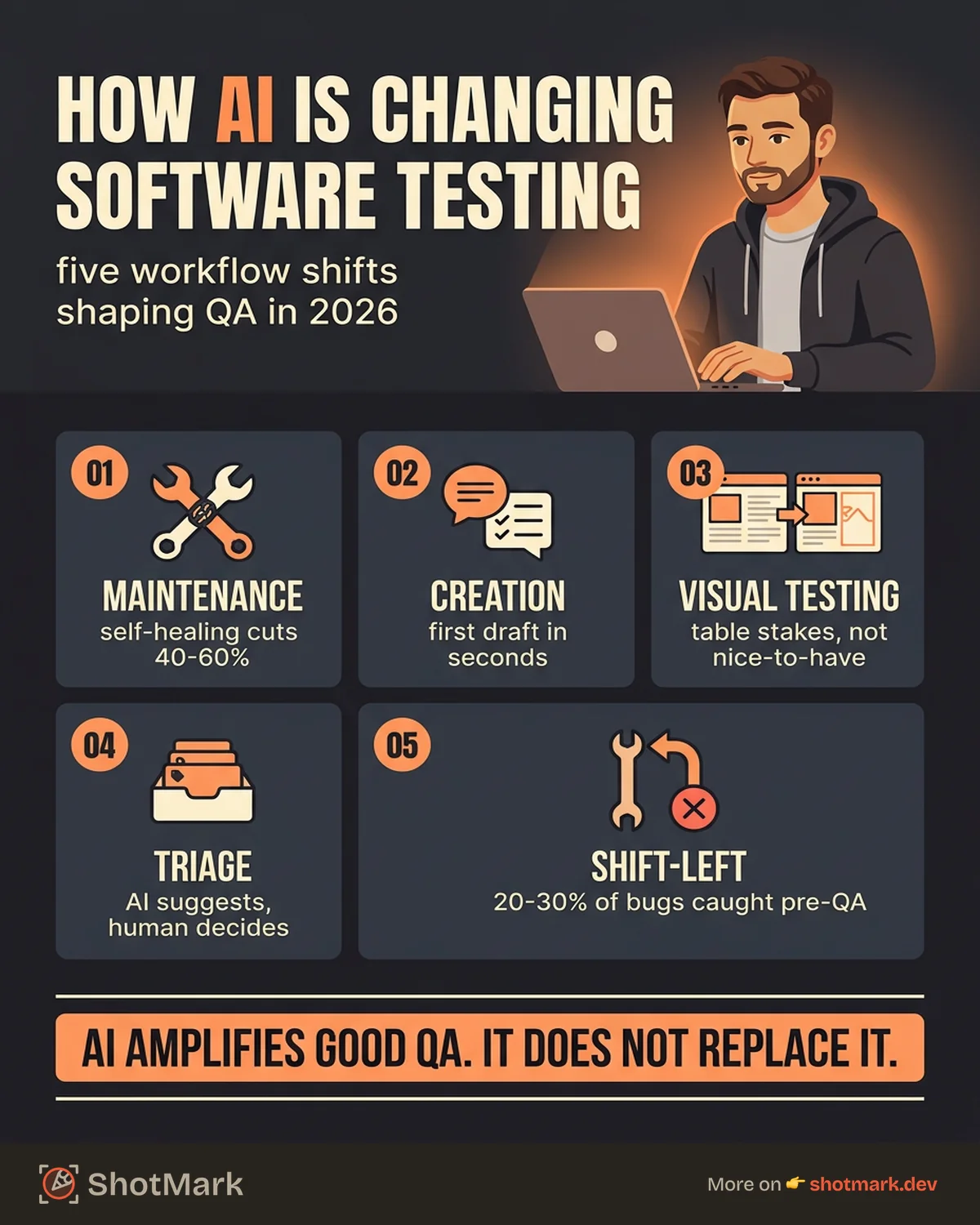
Five Ways AI Is Changing QA Workflows
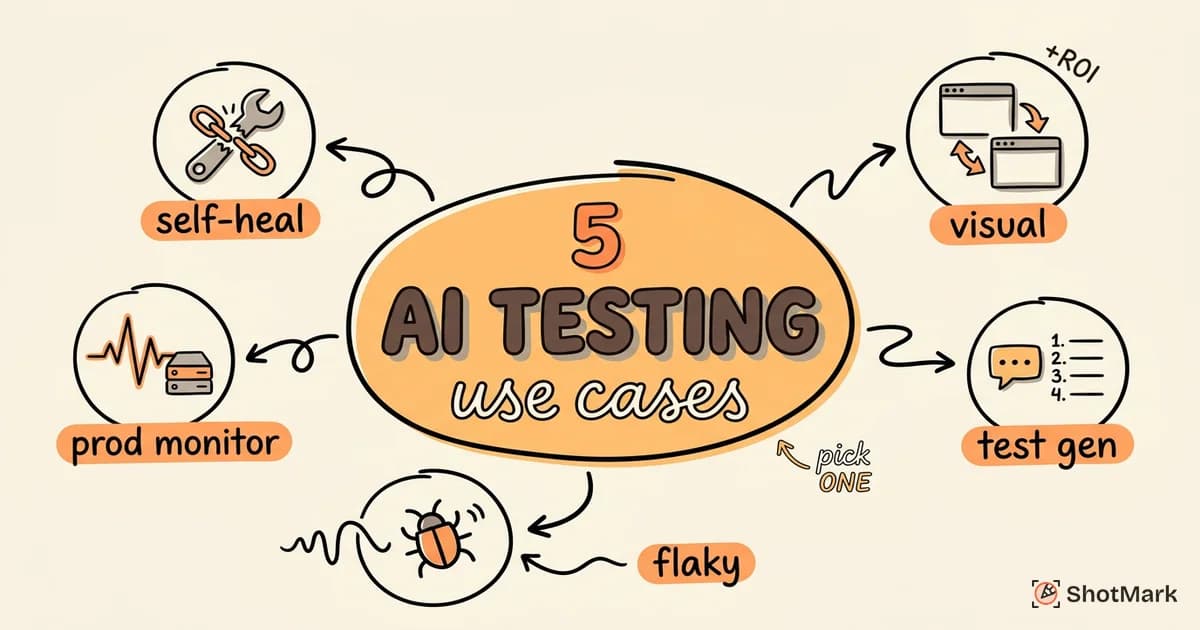
The impact of AI on testing is not theoretical. Here are the five most significant changes we see in production QA teams right now.
Test Maintenance Is Becoming Automatic
Test maintenance has always been the silent killer of automation initiatives. Tests break because a selector changed, a button was renamed, or a page was restructured. The test logic is fine, but the implementation details shifted. Teams spend 30-50% of their automation time on maintenance rather than writing new tests.
Self-healing locators address this. When a test fails because an element cannot be found, the AI searches for similar elements nearby and updates the locator automatically. Teams using self-healing report a 40-60% reduction in test maintenance time, according to multiple tool vendors and community discussions on Ministry of Testing.
The impact compounds over time. A team that saves 10 hours per week on maintenance redirects those hours to new test coverage. After six months, the gap in coverage between teams using self-healing and teams that are not becomes significant.
Test Creation Is Faster (But Not Fully Automated)
NLP-based test writing lets QA engineers describe test scenarios in plain language and have the tool generate executable test scripts. AI-generated test cases from user stories and PRDs are now standard practice for teams using tools like Testsigma and BotGauge.
The speed improvement is real. A test case that takes 30 minutes to write manually can be drafted by AI in under a minute. But the draft still needs human review, especially for business logic and edge cases. AI accelerates the first draft. It does not replace the final review.
The teams getting the most value treat AI as a first-draft engine. The QA engineer reviews, refines, and adds domain-specific cases that the AI could not infer. The total time savings is typically 40-50%, not the 90% that marketing materials suggest.
Visual Testing Is Standard Practice
Visual regression testing went from “nice to have” to table stakes in about 18 months. Tools like Applitools and Percy made it easy enough that teams no longer justify the cost. They justify not having it.
The AI component handles the hard part: distinguishing between meaningful visual changes (a button disappeared) and irrelevant ones (sub-pixel rendering differences). This filtering is what made visual testing practical at scale. Before AI-powered diff analysis, visual testing generated so many false positives that many teams abandoned it.
Teams that adopt visual testing typically catch 10-20% more UI bugs than they did with functional tests alone. These are bugs like overlapping elements, truncated text, and responsive layout breaks that functional assertions never check for.
Bug Triage Is Getting Smarter
AI-assisted triage handles two time-consuming tasks: severity classification and duplicate detection. Models trained on historical bug data can suggest severity levels based on the affected component, error type, and user impact. Duplicate detection compares incoming bug reports against the existing backlog and flags potential overlaps.
This does not replace triage judgment. It surfaces the information faster so the person making the decision has better data. A QA lead who used to spend an hour on triage every morning can now do it in 15 minutes, with AI handling the initial sorting and flagging.
The accuracy of AI triage depends heavily on the quality of your historical data. Teams with well-organized bug backlogs (consistent severity labels, clear component tags) see better results than teams with messy trackers. If your bug database is inconsistent, clean it up before adding AI triage. The model learns from your patterns, so garbage in means garbage out.
Shift-Left Testing With AI Code Analysis
AI-powered static analysis tools now catch bugs in pull requests before they reach QA. Snyk, CodeClimate, and similar tools flag potential issues in code as it is written. This is the earliest possible shift-left: bugs caught during development, before they ever enter a test cycle.
The impact on QA workload is significant. Teams report that 20-30% of bugs that would have been found during testing are now caught in code review, freeing QA time for more complex testing. The bugs that still reach QA tend to be the harder ones: integration issues, business logic errors, and edge cases that static analysis cannot detect.
What Hasn’t Changed (Despite the Hype)
Some things in testing have not changed, and they probably will not anytime soon.
Manual exploratory testing remains essential. No AI tool can replicate the creative, context-driven exploration that a skilled tester brings. The tester who asks “what happens if I do this weird thing” is providing value that automation cannot. Exploratory testing finds bugs that nobody thought to write a test for, which is precisely why it is irreplaceable.
Test strategy still requires human judgment. Deciding what to test, how deeply, and where to focus resources is a strategic decision that depends on business context, release risk, and team capacity. AI can inform the decision with data. It cannot make the decision.
Bug reporting still needs human context. Even when AI detects an anomaly, someone needs to communicate it to the team with enough detail to act on. This means AI bug detection catches issues, but human reporters still bridge the gap between detection and resolution. The detection is automated. The communication is not.
Preparing Your QA Team for AI
The QA engineers who thrive in 2026 and beyond are not the ones who resist AI or the ones who blindly adopt it. They are the ones who learn to evaluate and use AI tools as part of their workflow.
Develop skills in AI tool evaluation. Not every AI testing tool delivers on its promises. Learn to run proof-of-concept tests, measure actual time savings, and identify where the tool adds value versus where it creates noise. The ability to say “this tool does not work for our use case” is as valuable as knowing which one does.
Strengthen exploratory testing and test strategy skills. These are the areas where human QA adds the most value, and they become more important as AI handles more of the routine work. The future of QA testing belongs to testers who combine AI proficiency with deep testing expertise.
Learn prompt engineering for test generation. The quality of AI-generated test cases depends on the quality of your prompts. Teams that invest in prompt templates and structured input formats see significantly better results than teams that paste user stories into ChatGPT and hope for the best.
The career trajectory for QA engineers is not “replaced by AI.” It is “QA engineer who uses AI.” The distinction matters. The tools change, the fundamentals of quality assurance do not.
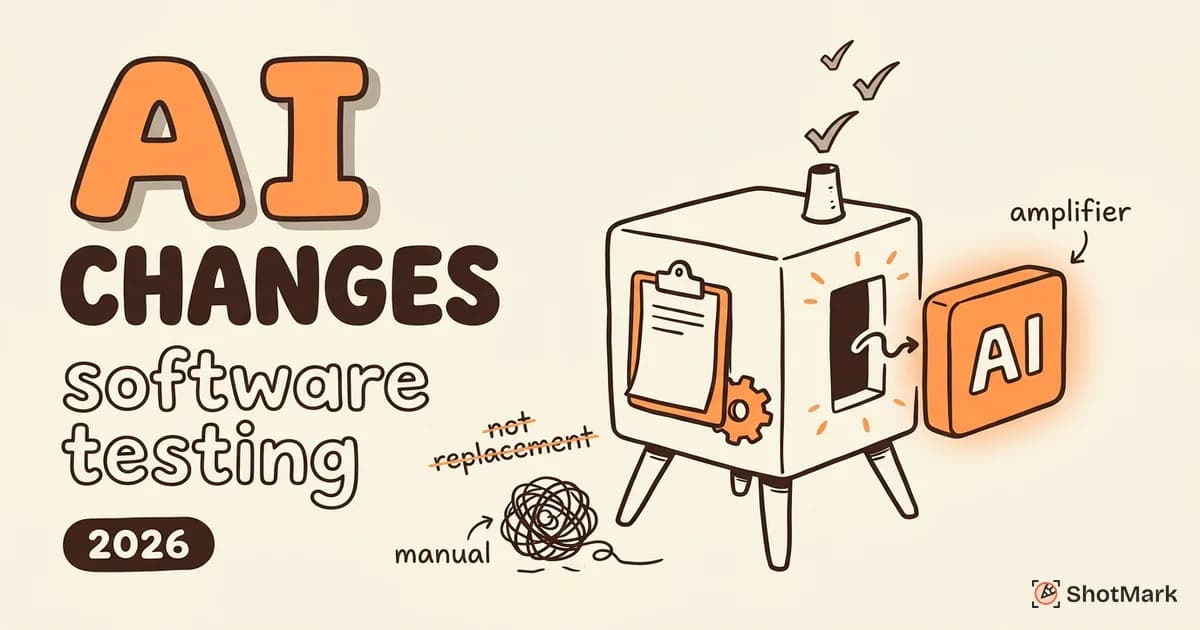
AI in software testing is an amplifier, not a replacement. It makes good QA teams faster and more thorough. It does not substitute for testing expertise, domain knowledge, or the ability to communicate bugs clearly. When your team finds an issue, ShotMark captures the full picture in one click: screenshots, console logs, network requests, and environment details. Join the waitlist.
Get new posts in your inbox.
One email when we publish: notes on QA, AI, and shipping faster. No spam, unsubscribe anytime.