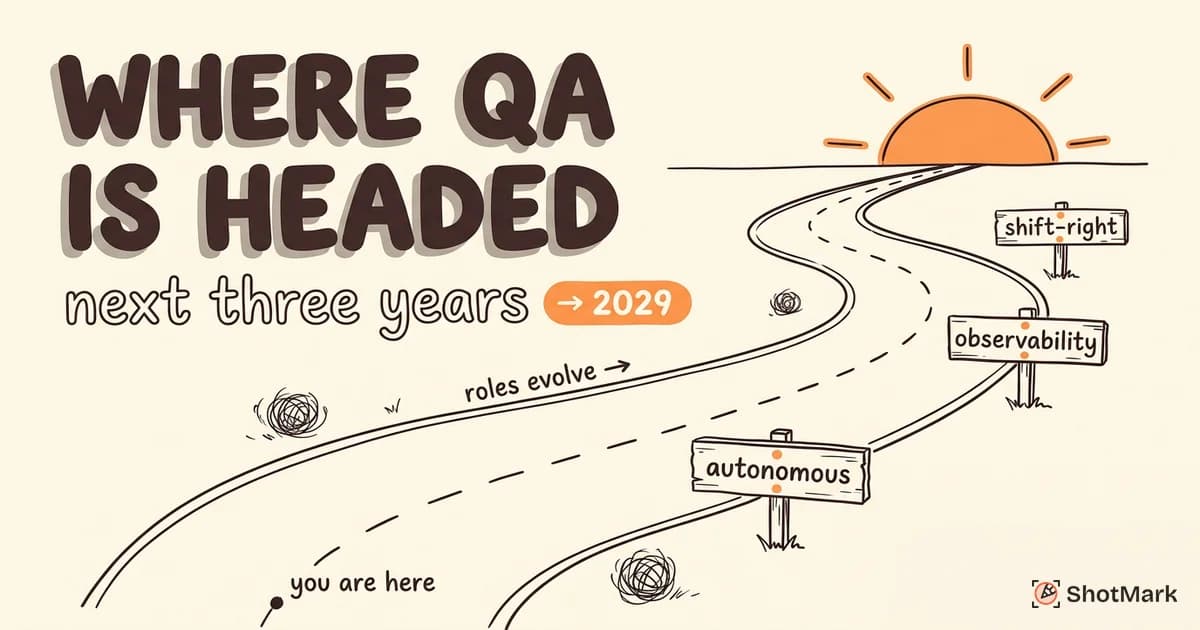
QA testing in 2029 will look as different from today as today looks from 2020. Three years ago, most teams were still debating whether AI belonged in their testing pipeline. Now the debate has shifted to how much AI to use and where humans add the most value.
We have been watching these shifts across the QA tools landscape, reading the ThoughtWorks Technology Radar, and tracking patterns from teams that adopt early. Based on where tools, teams, and technology are heading, here are the trends we expect to shape the future of QA testing through 2029.
Trend 1: Autonomous Testing Becomes Mainstream
The jump from “AI assists testers” to “AI tests autonomously” is already happening. AI agents that explore applications and generate tests without human guidance are moving from prototypes to production use.
AI testing tools like QA Wolf and Momentic already deploy autonomous agents that navigate web applications, interact with elements, and report anomalies. Over the next three years, these agents will become more capable and more reliable, handling routine smoke tests, regression checks, and basic exploratory testing without human initiation.
The human role in this shift moves from “writing and executing tests” to “overseeing test strategy and reviewing results.” Testers will manage AI agents the way senior engineers manage junior developers: setting direction, reviewing output, and handling the complex cases.
This does not mean autonomous testing replaces your test suite. It means your test suite has a new category: tests that no human wrote and no human maintains. The AI generates them, executes them, and updates them as the application changes. Humans review the results and decide what to investigate further.
Trend 2: Observability-Driven Testing
Right now, testing and monitoring are separate disciplines. Your QA team tests before release. Your observability tools monitor after release. The gap between them is where bugs escape.
That gap is closing. Over the next three years, production monitoring data will directly feed test priorities. Error monitoring tools like Sentry and Datadog will integrate with test management platforms, automatically generating test cases from real user errors.
The loop works like this: an error appears in production, the system correlates it with a code change, a test case is generated to cover the regression, the test runs automatically in CI, and the result feeds back into coverage tracking. Real user behavior shapes test coverage in real time, rather than QA engineers guessing what to test next.
This changes how teams think about coverage. Instead of measuring coverage by what code paths your tests exercise, you start measuring by what user behavior your tests reproduce. The gap between the two is where the most impactful bugs hide.
For QA teams, this means building closer relationships with the teams that own observability. The QA engineer who can read a Sentry error report and translate it into a test case is more valuable than the one who only writes tests from requirements. The skill set expands from “testing before release” to “ensuring quality across the entire lifecycle.”
Trend 3: QA Roles Evolve, Not Disappear
The most common fear among QA professionals is that AI will eliminate their jobs. The data from the Gartner Hype Cycle and the World Quality Report suggests something different: roles are evolving, not disappearing.
The shift goes from “tester” to “quality engineer.” QA professionals spend less time writing repetitive test cases and more time on test strategy, risk assessment, and cross-functional quality advocacy. AI tool evaluation becomes a core skill. The ability to assess whether an AI testing tool actually improves quality, rather than just adding automation theater, is already valuable and will become essential.
Exploratory testing becomes higher-value. As AI handles more routine testing, the bugs that matter most are the ones that require human creativity and domain knowledge to find. The changes AI is bringing to software testing free QA engineers to focus on exactly this kind of work.
The career path for QA professionals broadens. Some move toward test automation engineering, building and maintaining the AI-powered testing infrastructure. Others move toward quality strategy, working with product and engineering leadership to define what quality means for their organization. Both paths are more senior, more strategic, and more valuable than traditional manual testing roles.
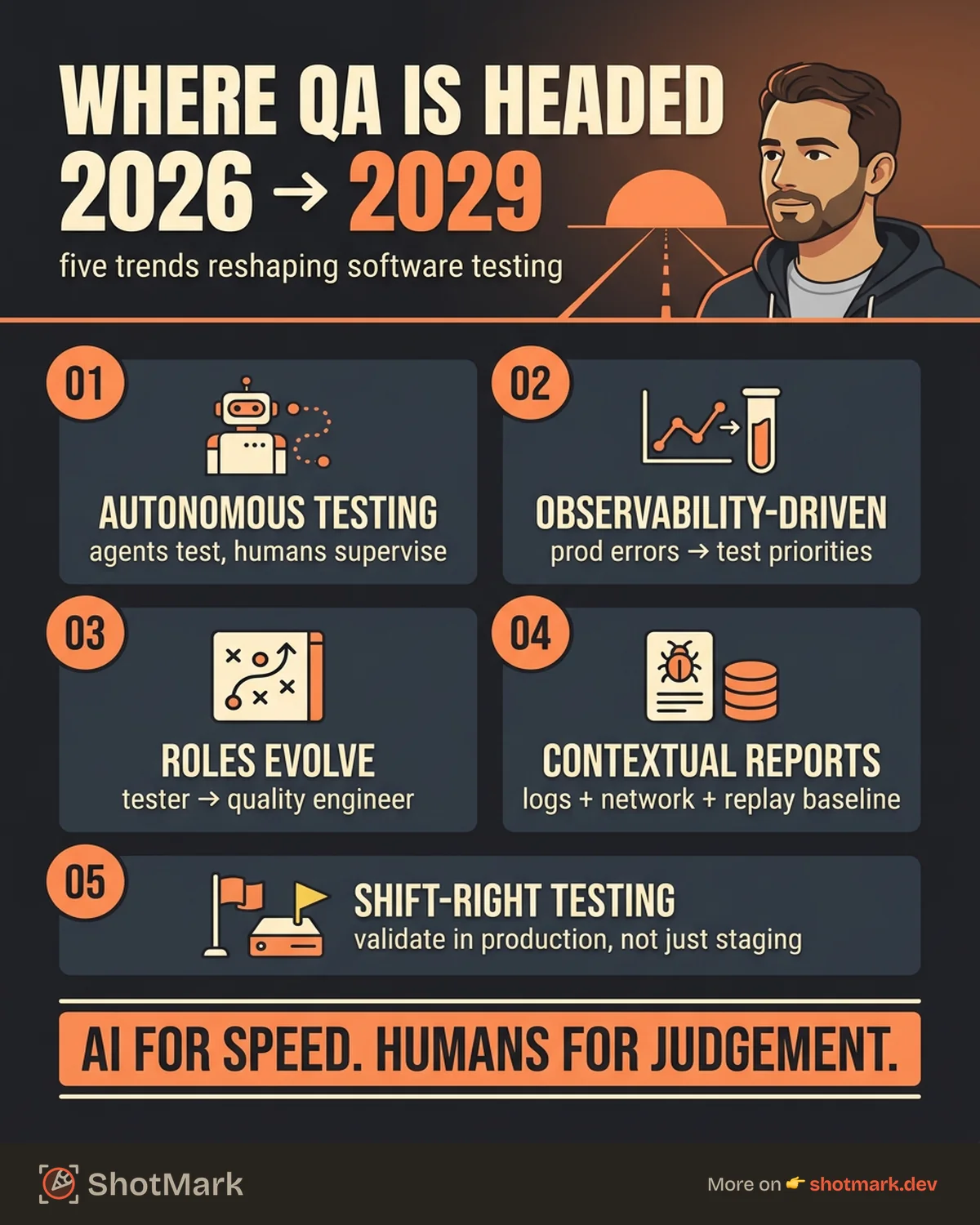
Trend 4: Visual and Contextual Bug Reporting
Bug reports are getting richer, and the trend accelerates over the next three years.
Today, the best bug reports include screenshots with annotations, console logs, network requests, and environment details. Capturing all of that manually takes 10-15 minutes per bug. Over the next three years, this context will be captured automatically.
Monitoring data will generate bug reports automatically. Session replay will be attached to every reported issue. AI will pre-fill severity, suggest affected components, and identify potential duplicates. Human reporters will review, add context, and approve. The workflow shifts from manual context gathering to human review and approval of AI-assembled reports.
The standard for what constitutes a complete bug report will rise. Today, a bug report with a screenshot and reproduction steps is considered thorough. In three years, teams will expect console logs, network traces, session replay, and environment metadata as baseline. Reports without this context will be sent back, the same way reports without reproduction steps are sent back today.
The impact on developer productivity is significant. Developers currently spend 20-30% of bug-fix time on back-and-forth with QA, asking for reproduction steps, environment details, and missing context. Automated context capture eliminates most of that. The developer gets a complete bug package and starts fixing immediately.
This is the direction ShotMark is built for. One-click capture of everything a developer needs: screenshots, annotations, console logs, network requests, and session context. The human reports the bug. The tool handles the assembly.
Trend 5: Shift-Right Testing Grows
Shift-left testing (catching bugs earlier in the development cycle) has been the dominant theme for the past decade. The next phase is shift-right: testing in production with confidence.
Feature flags enable this. Teams deploy code behind flags, expose it to a percentage of users, monitor for issues, and roll back automatically if error rates spike. Canary deployments work the same way: release to a small subset, verify, expand.
A/B testing becomes a quality validation tool, not just a product optimization tool. If a new feature passes automated tests but causes users to drop off, the A/B test catches what testing missed. The convergence of quality metrics and product metrics means QA teams start looking at the same dashboards as product managers.
The infrastructure for shift-right testing already exists. LaunchDarkly, Split, and similar platforms provide the flagging and targeting. Observability tools provide the monitoring. What changes over the next three years is that shift-right becomes a standard QA practice, not a DevOps experiment. QA teams own production quality validation alongside their pre-release testing.
This requires a cultural shift. QA teams that have only tested in staging environments need to build fluency with production metrics: error budgets, latency percentiles, and user-facing availability. The teams that make this transition early will have a significant advantage in catching bugs that only appear under real traffic conditions.
What Won’t Change
Some fundamentals of QA are technology-proof. They matter regardless of what tools you use.
Human judgment in quality decisions is irreplaceable. Deciding whether a bug is worth fixing, whether a release is ready, or whether test coverage is sufficient requires context that no tool provides. This is a judgment call informed by data, not a calculation performed by it. The product manager knows that the payment bug affects a high-value segment. The QA lead knows that the login regression has been a recurring problem. These decisions require people who understand the business, not just the code.
Communication between QA and development remains critical. The best test suite in the world does not help if the bug reports are unclear, the severity is wrong, or the reproduction steps are missing. Deciding whether to build or buy your AI QA automation is one thing. Communicating what you find is another.
Well-written bug reports retain their value. As testing gets more automated, the human contribution to quality increasingly centers on how clearly and completely issues are communicated to the people who fix them. The tools change. The need for clear, actionable bug reports does not.
The best QA teams in 2029 will use AI for speed and humans for judgment. That balance is already visible in the most effective teams today. The tools get better, the workflows evolve, but the core dynamic holds: technology amplifies human expertise, it does not replace it. ShotMark is built for exactly this future of QA testing. Fast, contextual, collaborative bug reporting that lets human testers focus on finding issues while the tool handles capture and communication. Join the waitlist.
Get new posts in your inbox.
One email when we publish: notes on QA, AI, and shipping faster. No spam, unsubscribe anytime.