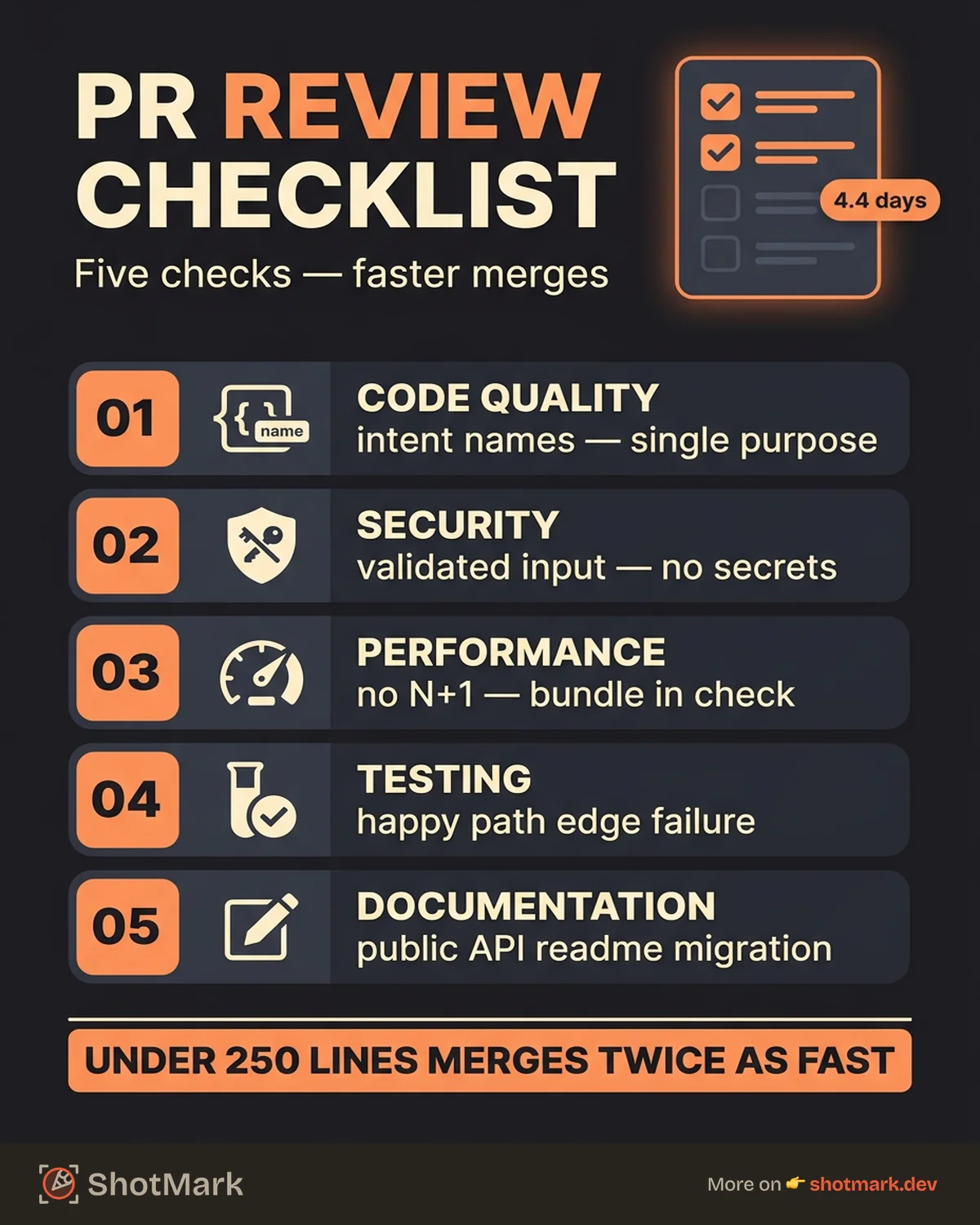
The average pull request sits open for 4.4 days before it merges, and most of that delay has nothing to do with code complexity. It comes from unclear review expectations, back-and-forth comments, and reviewers who each focus on different things. A shared pull request review checklist fixes this by giving every reviewer the same criteria and cutting the guesswork on both sides.
This guide gives you that checklist. We’ll walk through what to check before you even open the diff, the five review categories that catch 90% of issues, the anti-patterns that quietly slow your team down, and a copy-paste template you can drop into your repo today.
Before You Review: Context Gathering
Good reviews start before the first line of code. Jumping straight into the diff is how you miss the point of the change and end up nitpicking syntax instead of catching real bugs.
Read the PR description first. If it doesn’t explain the “why,” ask the author to add it before you review. Google’s own Code Review Developer Guide recommends the same thing: understand the intent before evaluating the implementation.
Check the linked issue or ticket next. A PR that claims to “fix the login bug” should match what the ticket actually describes. Scope creep is easier to catch when you know the original ask.
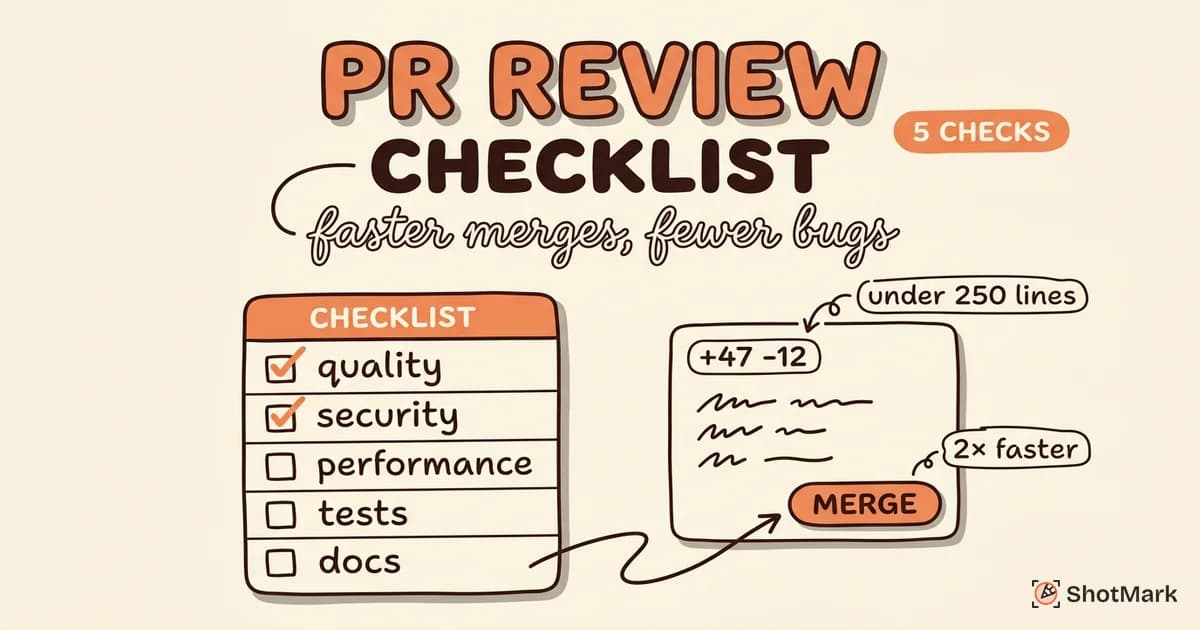
Finally, look at the diff size. Research from DORA and the GitHub State of the Octoverse shows that PRs under 250 lines merge roughly twice as fast as larger ones and catch more defects per line reviewed. If the diff is over 400 lines, ask the author to split it. You’re not being difficult. You’re doing your job.
One more thing before you open the diff: check the CI status. If the build is red or tests are failing, stop. Ping the author, ask them to fix the pipeline first, and come back. Reviewing code that doesn’t compile or doesn’t pass tests is a tax on your attention that pays nothing back.
The Pull Request Review Checklist
Here’s the checklist itself. Work through each category in order. Skipping ahead to security before reading for clarity tends to produce worse reviews, not better ones.
Code Quality Checks
Code quality is about whether the code is easy to read, change, and delete later. It’s not about whether you personally would have written it the same way.
- Names describe intent, not implementation (
filterActiveUsers, notdoFilter) - No duplicated logic that should be extracted (DRY, but don’t abstract after one use)
- Each function has a single responsibility
- Edge cases are handled (empty arrays, null inputs, network failures)
- Errors are caught at the right layer, not swallowed silently
- Readability beats cleverness every time
If a reviewer needs a comment to understand a line, the code probably needs rewriting, not commenting.
One thing to watch for: premature abstraction. Junior devs often introduce a factory or a generic helper for code that only has one caller. Senior reviewers know to push back on that. Concrete code that’s duplicated twice is usually clearer than an abstraction that tries to cover three future cases that may never arrive.
Also pay attention to how state flows. Mutable globals, shared singletons, and side effects hiding inside innocent-looking functions are the most common source of “I don’t understand why this broke” bugs three sprints from now.
Security Checks
Security issues get past reviews because they hide inside code that “works.” The checklist needs to force you to look for them explicitly.
- User input is validated and sanitized
- SQL queries use parameterized statements, never string concatenation
- Output is escaped to prevent XSS in rendered HTML
- Authentication and authorization checks exist on every protected route
- No secrets, API keys, or credentials are committed
- Dependencies added to the PR don’t introduce known CVEs
If your team ships web apps, run through the OWASP Top 10 once a quarter so these checks stay top of mind.
Performance Checks
Performance regressions are easy to miss because they don’t fail tests. They just make things slow.
- No N+1 queries (loops that hit the database once per item)
- Database queries use appropriate indexes
- React components don’t re-render on every parent update (memo, useCallback, stable keys)
- Bundle size impact is acceptable for new dependencies
- Caching is considered for expensive computations or fetches
- Large lists use virtualization, not full renders
A 200ms regression on a hot path is worse than a bug that affects 1% of users. Catch it in review.
If the PR touches a known-hot code path, ask the author to include before-and-after measurements in the description. “Feels fast enough” is not a benchmark. A profiler output, a Lighthouse score, or a simple timing log is.
Testing Checks
Tests prove the code works and make future refactors safe. A PR without tests is a PR that future you will regret.
- New logic has unit tests covering happy path, edge cases, and failures
- Integration tests cover multi-component workflows
- Existing tests still pass in CI
- Coverage hasn’t regressed on touched files
- Tests are readable and test behavior, not implementation details
- Flaky tests are fixed, not retried
If the CI checks fail, don’t review yet. Ask the author to fix them first. Reviewing broken code wastes both of your time.
Documentation Checks
Documentation is the part reviewers skip most often, and it’s the part future engineers depend on most.
- Public APIs have updated JSDoc, docstrings, or type comments
- README reflects new setup steps, commands, or environment variables
- Breaking changes are called out in the PR description and changelog
- Migration notes exist for schema or config changes
- Comments explain the “why,” not the “what”
A good rule: if you had to ask a question during review, the answer probably belongs in a comment or the README.
Common PR Review Anti-Patterns
Even teams with a solid checklist fall into a few predictable traps. Watch for these in yourself before you watch for them in others.
Rubber stamping: Approving within 30 seconds of the PR opening, every time. The author learns that your review means nothing, which means the next reviewer bears all the weight. Atlassian’s code review best practices put this at the top of their list of review failures for a reason.
Nitpicking: Blocking a merge on a trailing comma or a variable name you personally dislike. If a linter or formatter can catch it, configure the linter. Don’t make it a human job.
Ghost reviewing: Opening the PR, scrolling through, closing the tab, and leaving no comment. The author has no idea if you approved, rejected, or just forgot. If you don’t have time to review properly, reassign it.
Scope expansion: Asking the author to also fix unrelated issues you spotted in neighboring code. File a separate ticket. Keep this PR focused.
Silent disagreement: Approving a change you actually disagree with because you don’t want conflict. If it’s worth thinking, it’s worth writing down. Use GitHub’s review features to leave comments without blocking the merge if your concern is minor.
Tools That Speed Up PR Reviews
The checklist handles the “what.” Tooling handles the “how fast.”
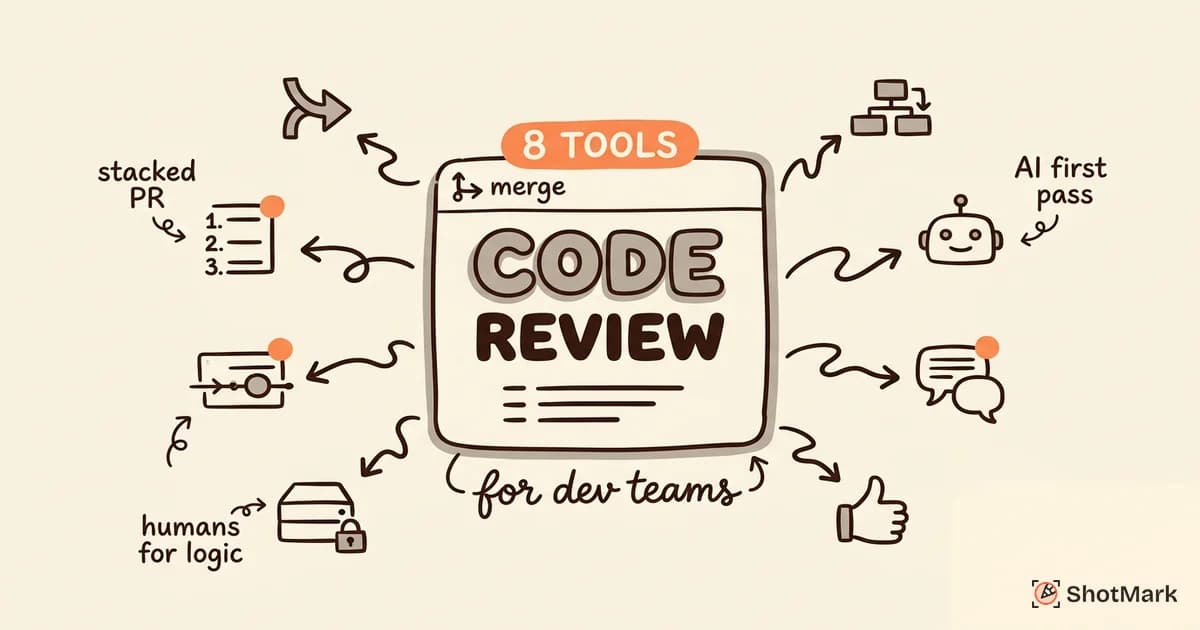
AI-assisted review bots now catch a meaningful share of obvious bugs, style issues, and missing tests before a human ever opens the PR. They’re not a replacement for human judgment, but they shorten the feedback loop. Pair them with the right platform tooling and you can shave hours off every cycle. Our roundup of the best code review tools for dev teams in 2026 breaks down which ones actually help and which ones add noise.
Stacked PRs are another underrated speedup. Instead of one 800-line PR, you ship five 160-line PRs that each depend on the previous one. Reviewers move faster because each diff is small, and you avoid the monster-PR problem entirely.
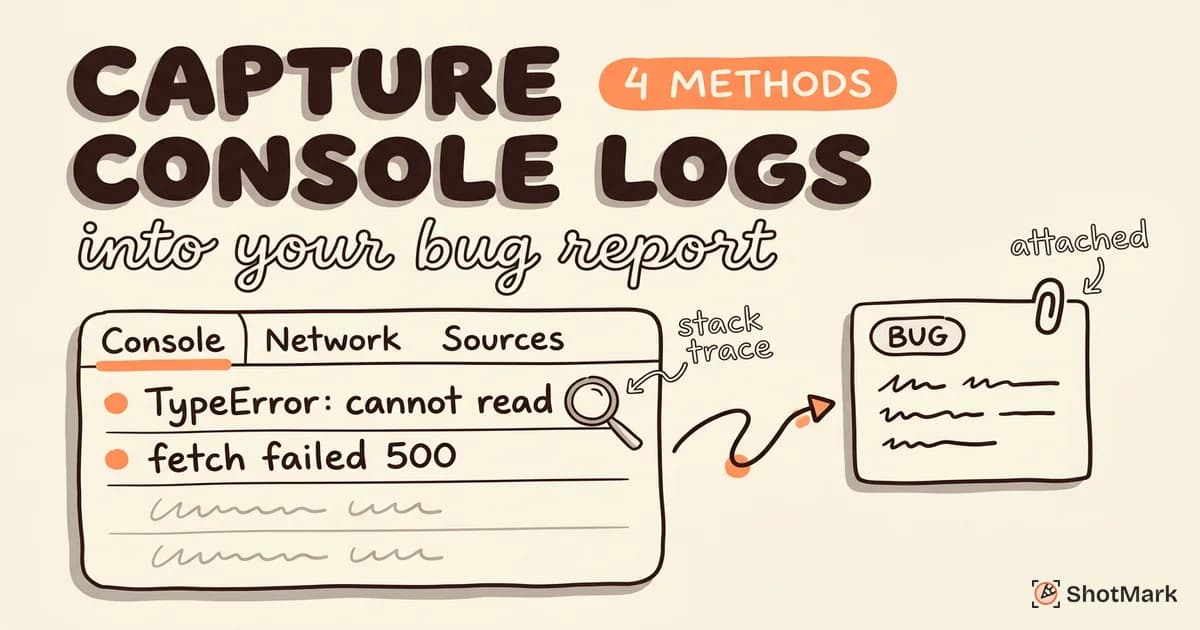
Visual evidence matters too, especially for UI changes. “The button looks weird” is not a review comment anyone can act on. A screenshot with an annotation and the console log is. This is where ShotMark helps: one-click capture of screenshots, console logs, network requests, and session replay, pasted straight into your PR comment or linked ticket. Reviewers stop asking “what browser?” and start fixing the actual problem.
Teams that want to push further can also pair this with better overall tooling. We maintain a list of developer productivity tools senior devs use if you want to see what’s working elsewhere.
How Do You Review a Pull Request Effectively?
Start by reading the description and the linked ticket. Then scan the file tree to understand the shape of the change before reading any code. Work through the checklist categories in order (quality, security, performance, testing, docs), and batch your comments instead of drip-feeding them over the day. Finish with a clear verdict: approve, request changes, or comment. Never leave the author guessing.
What Are Pull Request Review Best Practices for Teams?
Agree on a maximum diff size. Rotate reviewers so knowledge spreads. Keep a single pinned checklist in the repo so every reviewer uses the same criteria. Set a service-level target for first response (four hours is a common goal) and track it. And separate “must fix” comments from “nice to have” ones explicitly, so authors know which comments block the merge and which don’t.
How Do You Get Faster Pull Request Merges Without Cutting Corners?
Smaller PRs and clearer descriptions do most of the work. Add a required CI pipeline with linting, tests, and type checks so humans only review what machines can’t. Automate code formatting so style never shows up in comments. And capture rich bug context, screenshots, console logs, network calls, so reviewers don’t have to ask for reproduction steps.
Downloadable Checklist Template
Copy this into a PULL_REQUEST_TEMPLATE.md file at the root of your repo. GitHub will auto-populate it every time someone opens a PR.
## Summary
{/* What does this PR do and why? Link the issue. */}

## Reviewer Checklist

### Context
- [ ] PR description explains the "why"
- [ ] Linked issue or ticket exists
- [ ] Diff is under 400 lines (or split justified)

### Code Quality
- [ ] Names describe intent
- [ ] No duplicated logic
- [ ] Edge cases handled
- [ ] Errors caught at the right layer

### Security
- [ ] User input validated
- [ ] No secrets in code
- [ ] Auth checks on protected routes
- [ ] New dependencies scanned for CVEs

### Performance
- [ ] No N+1 queries
- [ ] No unnecessary re-renders
- [ ] Bundle size impact acceptable
- [ ] Caching considered where useful

### Testing
- [ ] Unit tests for new logic
- [ ] Integration tests for workflows
- [ ] CI passes
- [ ] Coverage not regressed

### Documentation
- [ ] Public APIs documented
- [ ] README updated if needed
- [ ] Breaking changes called out
- [ ] Migration notes provided
Customize it. Remove the sections that don’t apply to your stack. Add ones that do. LinearB’s engineering benchmarks suggest teams with a shared template cut PR cycle time by 20 to 40% within the first quarter, so the customization is worth the 15 minutes it takes.
A shared pull request review checklist won’t write better code for you, but it will stop your team from relearning the same lessons on every merge. Use the template, run through the five categories, and skip the anti-patterns. When a bug does slip through and hits production, ShotMark captures the screenshot, console logs, network requests, and session replay in one click so the next pull request review has every detail it needs. Join the waitlist at shotmark.dev or follow along with the open-source SDK when it ships.
Get new posts in your inbox.
One email when we publish: notes on QA, AI, and shipping faster. No spam, unsubscribe anytime.