Hotjar made session replay and heatmaps accessible to product teams who didn’t have enterprise analytics budgets. That contribution matters. But in 2026, teams are asking for more than replay and heatmaps at a reasonable price. They want developer-grade session data, privacy-compliant replay, and bug context alongside behavior analytics. The market has caught up, and several Hotjar alternatives now offer session replay that’s sharper, more flexible, or more developer-friendly.
Finding the right hotjar alternative depends on what frustrated you about Hotjar in the first place. Maybe replay quality on your SPA is unreliable. Maybe the session caps on paid plans don’t match your traffic. Maybe you need self-hosting for compliance. Whatever the reason, the tools below address specific Hotjar gaps rather than just matching its feature set.
We compared eight alternatives on session replay quality, heatmap coverage, pricing transparency, privacy options, and whether they combine behavioral analytics with debugging features. Here’s what we found.
Why Teams Switch From Hotjar
Three reasons come up most often in our conversations with engineering and product teams.
Session replay quality is the first. Hotjar’s replays capture page changes and clicks, but they reconstruct sessions from DOM mutations rather than recording actual video. On single-page applications with dynamic content, Hotjar replays can miss visual states, show blank screens, or render sessions out of order. Teams with complex React, Vue, or Angular apps notice this gap most.
Pricing at scale is the second. Hotjar’s free tier covers 35 sessions per day, which works for small sites. Paid plans start at $32 per month for 100 daily sessions. Teams with moderate traffic (10,000+ monthly visitors) can hit the Plus plan’s limits quickly, and the jump to the Business plan ($80 per month) still caps sessions at the 500-per-day level. High-traffic sites pay significantly more.
Privacy and data control is the third. Hotjar is GDPR-compliant, but it’s a cloud-only product. Teams that need on-premise hosting, data residency in specific regions, or more granular consent management look elsewhere. A cheaper Hotjar alternative that also offers self-hosting is a hard combination to ignore if those constraints matter to your organization.
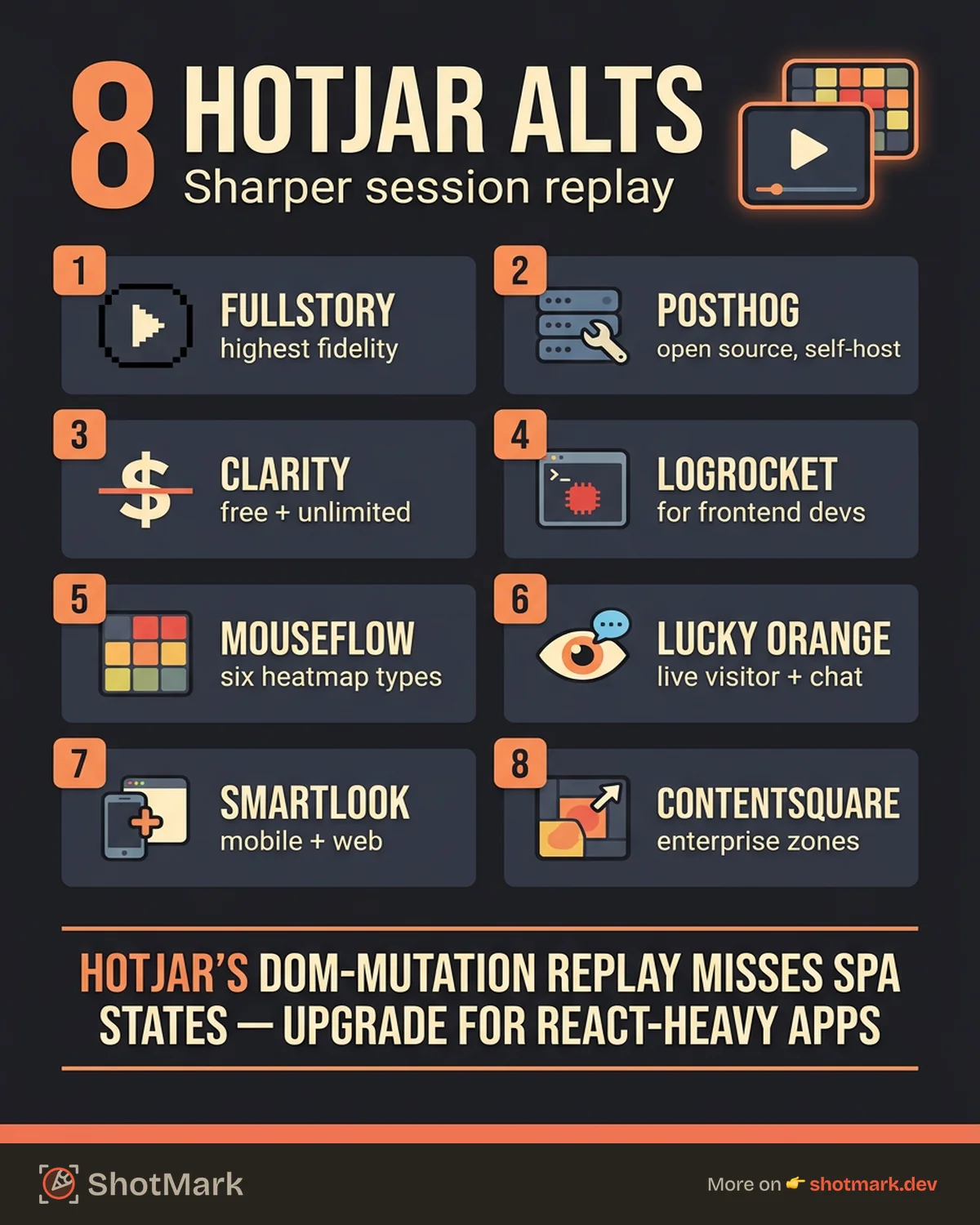
8 Hotjar Alternatives
FullStory
FullStory is the closest thing to an enterprise-grade Hotjar. It built its reputation on high-fidelity session replay and “search everything” analytics that let you find sessions matching specific user behaviors.
Strengths: Replay quality is the benchmark in this category. FullStory captures DOM state, network activity, and console errors alongside the visual replay. Search across all captured sessions is powerful for finding patterns. Frustration signals (rage clicks, dead clicks, thrashing) highlight problematic UX without manual review.
Weaknesses: Enterprise pricing is opaque and expensive. No free tier (only a trial). Overkill for teams that just need basic replay and heatmaps. Implementation requires developer resources for proper instrumentation, which adds setup time compared to simpler tools.
FullStory is the right hotjar alternative for teams that want the highest replay fidelity and can justify enterprise-level spending. It’s not the right pick for startups or small teams that need a quick, affordable upgrade from Hotjar’s replay quality.
For a deeper dive on FullStory competitors, see our FullStory alternatives for session replay in 2026 comparison.
PostHog
PostHog offers session replay as part of its open-source product analytics platform. It’s self-hostable, which makes it the go-to choice for teams with data residency requirements.
Strengths: Open-source and self-hostable. Combines replay with product analytics, feature flags, and error tracking. Free cloud tier covers 5,000 recordings per month. Privacy controls let you mask sensitive elements before capture.
Weaknesses: Replay fidelity is a step below FullStory and LogRocket on complex SPAs. Analytics features are deeper than the replay features, which shows in the documentation. Setup requires more configuration effort than Hotjar’s plugin approach.
Best for: Teams that want a hotjar alternative with better privacy controls and don’t mind self-hosting.
Microsoft Clarity
Microsoft Clarity is free with no traffic limits. That sentence alone explains why it’s on this list.
Strengths: Completely free, unlimited recordings and heatmaps. Dead click and rage click detection built in. Easy setup (one script tag). Good enough replay quality for most marketing and content sites.
Weaknesses: No product analytics beyond replay and heatmaps. Limited filtering and segmentation. No console log or network request capture. Data lives in Microsoft’s infrastructure with no self-hosting option.
Best for: Teams that want the hotjar alternative free tier that actually covers their traffic volume.
LogRocket
LogRocket is built for developers. It pairs session replay with error tracking, console log capture, and network request logging. The replay is high-fidelity, and the surrounding debugging context makes it more useful for bug reproduction than pure behavior analytics.
Strengths: Developer-focused session replay with console and network data. Integrates with Sentry, Datadog, and other error monitors. Redux, MobX, and Zustand state inspection during replay. Good for reproducing bugs, not just watching user behavior.
Weaknesses: Pricing scales with sessions and gets expensive. Not designed for marketing or UX research teams. Heatmap features are limited. The developer focus means non-technical stakeholders may find the interface less intuitive than Hotjar’s simplified dashboard.
If your primary use case is debugging frontend issues rather than running UX research studies, LogRocket is the strongest hotjar alternative for session replay on this list. The combination of replay, console logs, and network data in a single view saves significant investigation time.
For more on LogRocket and its competitors, see our LogRocket alternatives for frontend debugging post.
Mouseflow
Mouseflow sits closest to Hotjar in scope: session replay, heatmaps (click, move, scroll, attention), and form analytics. It’s a direct competitor with a slightly different pricing model.
Strengths: Six types of heatmaps including attention maps and geography views. Form analytics show field-level drop-off. Pricing is pageview-based rather than session-based, which can work better depending on your traffic pattern. GDPR-compliant with EU data hosting.
Weaknesses: Replay quality is comparable to Hotjar, not a clear step up. Fewer integrations. No console or network capture for debugging.
Best for: Marketing teams that want Hotjar’s feature set at a potentially lower cost depending on traffic patterns.
Lucky Orange
Lucky Orange adds live visitor viewing and chat to the standard replay and heatmap toolkit. You can watch visitors navigate your site in real time and start a chat with them.
Strengths: Live visitor view is unique in this price range. Built-in chat lets you ask visitors about their experience in the moment. Conversion funnels and form analytics included. Cheaper than Hotjar at comparable session volumes.
Weaknesses: UI feels dated. Replay quality is serviceable but not on par with FullStory or LogRocket. Chat feature is basic compared to dedicated live chat tools.
Best for: Small and mid-size businesses that want live interaction alongside session replay.
Smartlook
Smartlook records both web and mobile app sessions, which is the main reason teams pick it over Hotjar.
Strengths: Mobile session replay for iOS and Android alongside web. Event-based analytics let you filter sessions by specific user actions. Free tier covers 3,000 sessions per month. GDPR-compliant with data centers in the EU.
Weaknesses: Web replay quality trails FullStory and LogRocket. Heatmap features are basic. API and integration options are limited compared to Hotjar.
Best for: Teams that need mobile session replay alongside web and don’t want to run two separate tools.
Contentsquare
Contentsquare is the enterprise competitor to FullStory. It focuses on digital experience analytics with deep zone-based heatmaps, journey analysis, and merchandising insights.
Strengths: Deepest heatmap and zone analysis in this category. Journey mapping shows complex multi-page flows. Enterprise integrations and dedicated customer success. Good for large e-commerce and SaaS companies.
Weaknesses: Enterprise pricing only, no self-serve. Overkill for teams with simpler analytics needs. Requires a dedicated analyst to get full value.
Best for: Enterprise teams with dedicated UX research and analytics staff.
Comparison Table
| Tool | Replay Quality | Heatmaps | Self-Hosted | Free Tier | Pricing (Start) |
|---|---|---|---|---|---|
| FullStory | High | Yes | No | Trial only | Custom |
| PostHog | Medium | No | Yes | Yes | Free (cloud) |
| Microsoft Clarity | Medium | Yes | No | Yes (unlimited) | Free |
| LogRocket | High | Basic | No | Yes | $69/mo |
| Mouseflow | Medium | Yes | No | Yes | $31/mo |
| Lucky Orange | Medium | Yes | No | Yes | $16/mo |
| Smartlook | Medium | Basic | No | Yes | Custom |
| Contentsquare | High | Yes | No | No | Custom |
Session Replay and Bug Reporting Are Different Problems
Session replay tools show you what happened. A user clicked here, scrolled there, got confused by this modal. That’s valuable for UX research, conversion optimization, and understanding behavior patterns.
Bug reporting tools capture what went wrong. A console error fired, a network request timed out, a layout broke at a specific viewport. That’s valuable for QA teams and developers who need to reproduce and fix issues.
Most teams need both. You watch session replays to find problems, then file bug reports to fix them. ShotMark bridges this gap by capturing screenshots, console logs, network requests, and a short session replay in one click. The result is a shareable bug report with enough context for a developer to reproduce the issue without watching a 10-minute replay. For a broader look at tools in this space, our best bug reporting tools compared for 2026 roundup covers the capture side.
The best hotjar alternative depends on what you need replay for. Pure UX research? FullStory or Contentsquare. Developer debugging? LogRocket. Free and simple? Microsoft Clarity. Self-hosted with analytics? PostHog. Pick the tool that matches your primary use case, then pair it with a dedicated bug reporting tool for the issues replays reveal.
Get new posts in your inbox.
One email when we publish: notes on QA, AI, and shipping faster. No spam, unsubscribe anytime.