The later you find a bug, the more it costs to fix. A requirements defect caught during development costs 10x less than the same defect found in production, according to data from NIST’s Systems Sciences Institute. Shift left testing is the practice of moving testing activities earlier in the development lifecycle, before code is merged, before features are marked “done,” and ideally before code is even written.
For QA teams, this means changing when, where, and how they contribute. It’s not about adding more testing. It’s about testing at the right time.
What Is Shift Left Testing
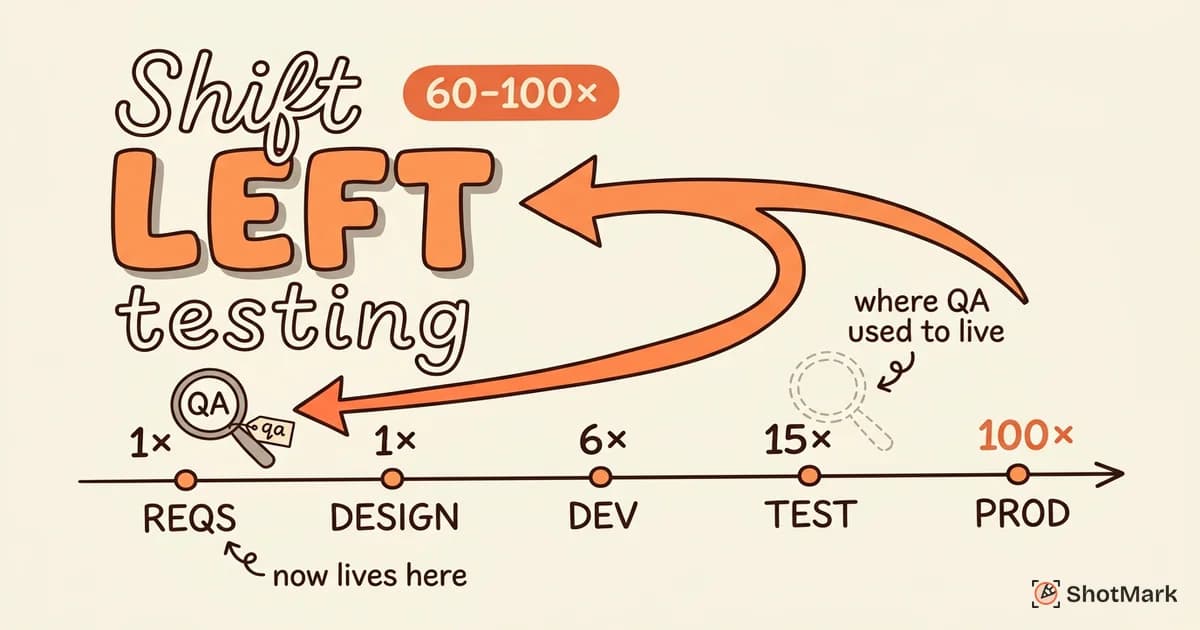
The term “shift left” comes from Larry Smith, who coined it in 2001 to describe the idea of moving testing earlier on the project timeline. If you picture a software development lifecycle as a timeline flowing left to right (requirements, design, development, testing, deployment), traditional QA sits near the right end. Shift left testing moves it toward the beginning.
The traditional model looks like this: developers write code, the build goes to QA, testers find bugs, developers fix them, and the cycle repeats until the release date arrives (or passes).
The shift left model looks different: QA reviews requirements alongside developers, writes acceptance tests before coding starts, runs automated checks on every pull request, and validates continuously rather than at the end.
The shift left testing meaning is straightforward. Test earlier, find bugs cheaper, and shorten the feedback loop between “bug introduced” and “bug fixed.”
Why Shift Left Testing Matters
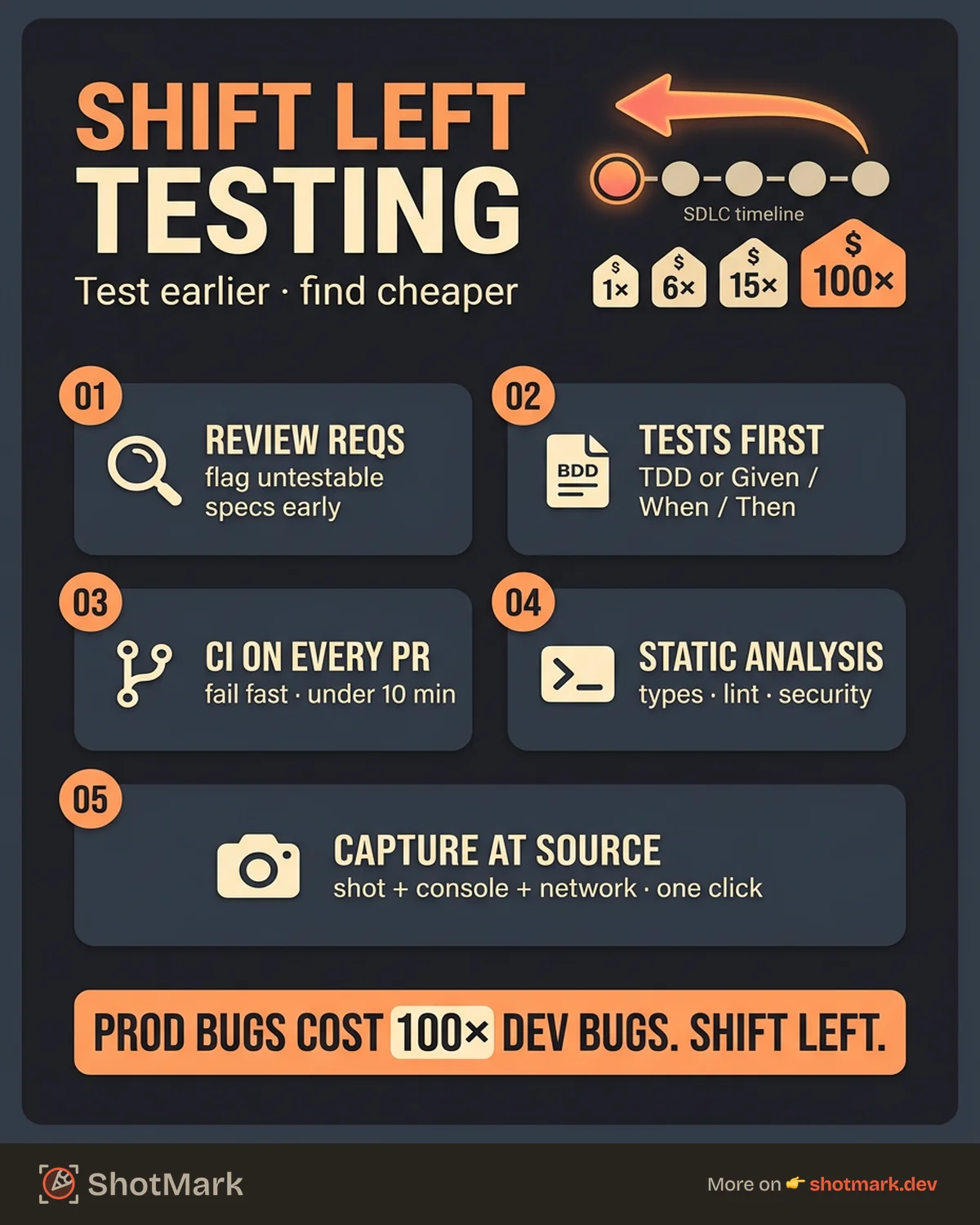
The economics are hard to argue with. Capers Jones’s research on defect removal efficiency shows that the cost of fixing a bug increases at every stage of the development lifecycle:
- Requirements phase: 1x cost
- Development phase: 6x cost
- Testing phase: 15x cost
- Production: 60-100x cost
Beyond cost, shift left testing delivers faster feedback loops. When a developer introduces a bug and a test catches it within minutes (via CI), they fix it while the code is still fresh in their mind. Compare that to a QA engineer filing a bug report two weeks later, when the developer has moved on to something else entirely.
Shift left also reduces regression risk. Bugs caught early don’t have time to compound. A data validation issue caught at the API level stays contained. The same issue caught in production might corrupt user data across multiple records before anyone notices.
Teams that practice shift left testing report better developer-QA collaboration and fewer production incidents. The World Quality Report from Capgemini consistently shows that organizations with mature testing practices integrated early in the lifecycle experience fewer release delays.
5 Ways to Implement Shift Left Testing
Knowing the definition is one thing. Actually shifting left requires specific changes to how your team works.
1. Include QA in Requirements Reviews
The cheapest testing you’ll ever do is reading a requirements document and asking “how would we test this?”
QA should review PRDs and user stories before sprint planning. They’re looking for ambiguities, missing acceptance criteria, and untestable requirements. A user story that says “the page should load quickly” is untestable. One that says “the page loads in under 2 seconds on a 4G connection” gives QA something concrete to verify.
This is also where QA identifies edge cases that product managers and developers might miss. What happens when the user’s session expires mid-checkout? What if the API returns a 500 error during file upload? These scenarios are easier to handle when they’re planned for, not discovered in production.
2. Write Tests Before or Alongside Code
Test-Driven Development (TDD) and Behavior-Driven Development (BDD) are the most structured forms of shift left testing.
In TDD, developers write unit tests before writing the implementation code. The test fails first, then the developer writes just enough code to make it pass. This keeps the codebase testable by design.
In BDD, QA and developers collaborate on acceptance tests written in a shared language (Given/When/Then). QA writes the acceptance criteria. Developers implement both the feature and the tests. By the time a feature is “dev complete,” the acceptance tests already exist.
You don’t need to adopt full TDD or BDD to benefit. Even writing acceptance tests during the first two days of a sprint (while development is starting) shifts testing significantly left.
3. Run Automated Tests in CI/CD
Every pull request should trigger automated tests: unit tests, integration tests, and smoke tests at minimum. If a test fails, the build fails. No exceptions.
This creates a fast feedback loop. A developer pushes code, CI runs tests in minutes, and failures are caught before the code is reviewed or merged. Without this, bugs hide in feature branches until QA discovers them days or weeks later.
The key is keeping CI test suites fast. If your test suite takes 45 minutes, developers will stop waiting for it. Aim for under 10 minutes on pull request checks. Move longer-running tests (full regression, performance) to nightly runs or pre-release pipelines.
4. Use Static Analysis and Linting
Static analysis catches entire categories of bugs without running the application. Type errors, security vulnerabilities, code smells, and accessibility issues can all be flagged before a human reviewer sees the code.
For web development teams, this means tools like TypeScript (strict mode), ESLint with security-focused rule sets, and SonarQube for deeper analysis. These tools run in seconds and catch issues that manual code review often misses.
Static analysis is the lowest-effort, highest-return shift left practice. It requires no behavioral change from developers beyond running the tools (which CI can enforce automatically).
5. Capture Bug Context at the Source
When bugs are found during development or early testing, the context around them is richest. The developer knows exactly what they changed. The QA engineer can see the console errors and network requests in real time.
The problem is that this context gets lost between finding a bug and reporting it. A QA engineer spots a broken checkout flow, switches to their bug tracker, types a description from memory, and maybe attaches a screenshot. By the time the developer reads the report, critical details are missing.
ShotMark solves this by capturing screenshots, console logs, and network requests in one click, right at the moment a bug is discovered. This preserves the full context and reduces the back-and-forth that slows down fixes. When shift left testing surfaces bugs earlier, having complete bug reports ensures those bugs get resolved quickly too.
Shift Left vs Shift Right Testing
Shift left and shift right are not opposites. They’re complementary strategies.
Shift left testing focuses on prevention. Test earlier, catch bugs before they reach production, and reduce the cost of defects.
Shift right testing focuses on detection in production. Feature flags, canary deployments, error monitoring (Sentry), and session replay tools help teams understand how software behaves under real user conditions.
The best practice is to apply both. Shift left for functional quality: does the feature work as specified? Shift right for operational quality: does the feature perform well under real traffic, on real devices, with real network conditions?
Teams that only shift left miss production-only issues (memory leaks under sustained load, edge cases from unexpected user behavior). Teams that only shift right catch bugs too late and at too high a cost. A balanced approach covers both sides.
Challenges of Shift Left Testing
Shift left testing requires a culture change, not just a tool change. Here are the most common obstacles and how to address them.
QA engineers need to be involved earlier: This means fewer people doing manual testing at the end of the sprint. Teams need to redistribute QA effort across the entire sprint, which can feel uncomfortable at first.
Developers may resist “more testing work.” Frame it differently. Writing tests before code isn’t extra work. It’s the same work done in a different order, with the benefit of fewer bugs to fix later. Show the data on defect costs to make the case.
Automation infrastructure takes time to build: You can’t shift left without automated tests in CI. If your team has zero automation today, start small: add smoke tests to your CI pipeline first. Expand to integration tests next. Full end-to-end automation comes later.
Process change meets inertia: Teams that have always tested at the end of the cycle will take time to adjust. Start with one shift left practice (like including QA in sprint planning) and add more as the team builds confidence.
Measuring ROI takes time: The benefits of shift left testing (lower defect costs, fewer production incidents) show up over weeks and months, not days. Track metrics like bug escape rate and time-to-fix from the start so you can demonstrate progress to stakeholders.
Here’s a practical shift left testing example. A team we know started by adding QA to their sprint planning meetings. In the first sprint, QA identified 12 missing acceptance criteria across 8 user stories. Three of those would have caused bugs that reached production. By sprint three, developers were writing clearer acceptance criteria on their own because they anticipated QA’s questions. The process change took 30 minutes per sprint and prevented an estimated 15-20 hours of production debugging per month.
Shift Left Testing in Agile Teams
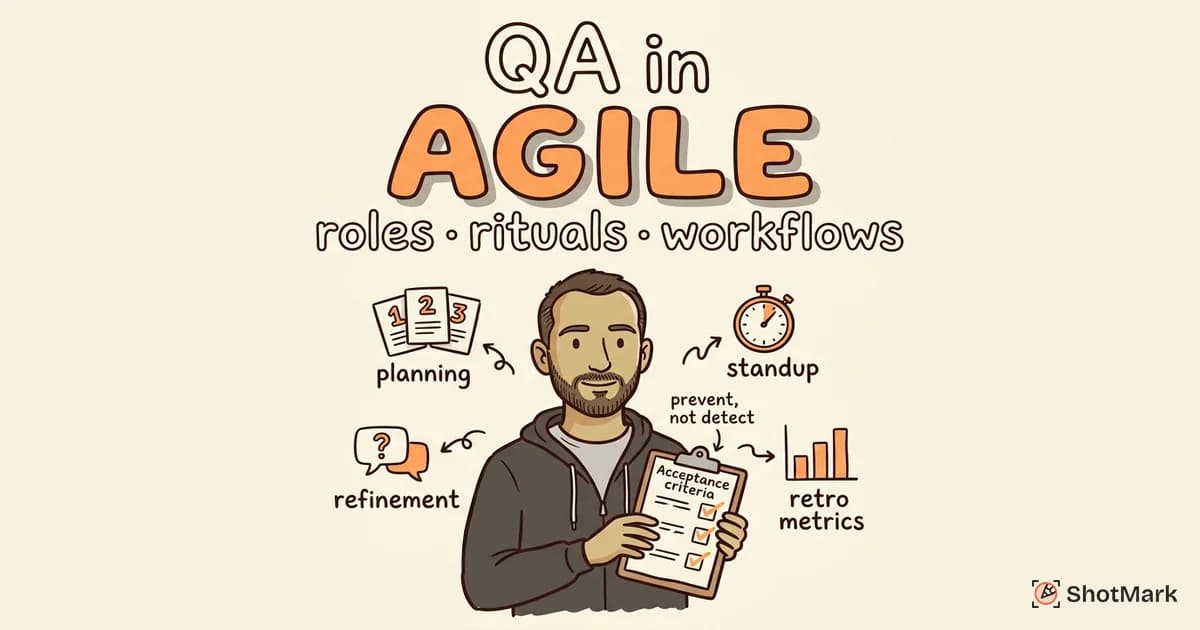
Shift left testing maps naturally to agile ceremonies.
Sprint planning: QA reviews user stories and adds acceptance criteria. Testing effort is estimated alongside development effort.
Daily standups: QA shares testing progress and blockers. Bugs found in the current sprint are discussed and triaged.
Sprint retrospectives: The team reviews which bugs were caught early vs late. This data drives process improvement.
Definition of Done: Update your DoD to include testing milestones. A feature is not “done” until unit tests pass, integration tests pass, and QA has verified the acceptance criteria.
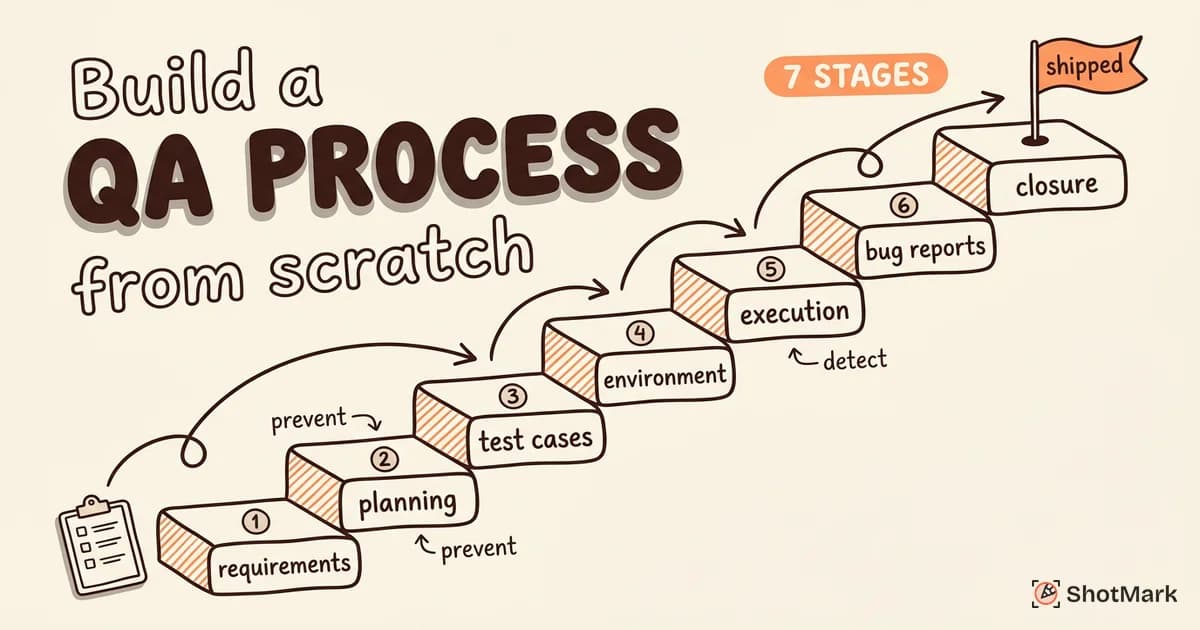
For a complete guide to embedding testing in your sprint workflow, see our post on agile testing practices for sprint-based teams. And for teams building their QA process from the ground up, our QA process guide covers the full 7-stage framework.
Where Shift Left Testing Takes Your Team
Shift left testing is not a one-time initiative. It’s a gradual evolution in how your team thinks about quality. Start with one practice, measure the impact on bug escape rates and time-to-fix, and expand from there.
The teams that get this right spend less time in reactive firefighting and more time building. They catch bugs when they’re cheap to fix, ship with higher confidence, and build a QA process that scales with their product.
ShotMark captures everything developers need to fix bugs fast: screenshots, console logs, and network requests in a single click. Join the waitlist .
Get new posts in your inbox.
One email when we publish: notes on QA, AI, and shipping faster. No spam, unsubscribe anytime.